Pages

Wednesday, June 13, 2012

Camouflaged Looper, revisited

   As a follow-up from yesterdays post, here are a few more shots of the amazing Camouflaged Looper, the caterpillar form of the Wavy-Lined Emerald moth. Last night I went out to check on them, and just happened to see one in the process of decorating himself. I tried my best to get a few photos of the process, as you can see by their size in relation to the salvia flower, they are really small, maybe 1 cm long. It looks like his natural "skin" color is kinda tan-ish brown, here he's taking a green piece of the plant and sticking it to his back (somehow!).


Tuesday, June 12, 2012

Happy, Happy Host Plants

Milkweed may be the most popular and well-known host plant (for Monarchs, of course) in our gardens, but many hundreds of different plants are "host" to the other 12,000 species of Lepidoptera. While I haven't seen any Monarch or Swallowtail caterpillars this year*, we do have a few other species hanging out in our yard, and they happen to be quite beautiful too!

Brown Hooded Owlet Moth, on Woodland Goldenrod (Solidago caesia)

White Marked Tussock Moth, on Pin Oak

Camouflaged Looper, on Salvia "May Night" (aka Wavy Lined Emerald Moth)

  Camouflaged Looper, dead center in the picture, about 1:00 in relation to the honey bee. In case you're unfamiliar with these guys, they affix pieces of whatever plant they are on to their bodies so they blend in. Totally the coolest!

Host plants aren't just for butterflies and moths, other insects have developed special relationships with particular plants too. What would you name a red beetle that lives exclusively on milkweed? How about Red Milkweed Beetle! How boring is that? Sorry for the blurry picture, I was leaning uncomfortably close over poison ivy to get this shot, with Jeff holding onto my pants!

*Well, we have seen a couple, but they didn't last long. Despite both Jeff and I watching a Monarch lay eggs, only one hatched that I could find, and that one disappeared after a couple of days. We also had one Spicebush Swallowtail caterpillar, but it too disappeared before maturing fully.  :-(

Friday, June 8, 2012

Random Acts of Cuteness

Since my last post may have inspired nightmares of flesh rotting spider bites, how about a few pictures of happy things that certainly ought to make anyone smile!

Ok, I know, bunnies are prolly on a lot of people's poop lists, but (so far) ours stay on the far edge of the yard up against the tall, unmowed grass line, and I haven't noticed any damage in the flower beds. I take it as another sign that we're providing a healthy habitat, especially since we cancelled our lawn service and the backyard is now full of clover!

Hey mister! Are you our Pater familias?

Seeing these little fellas hop around and chase each other really is cute, I guess it means we don't have any foxes in the neighborhood this year.

Ma and Pa Bluebird are currently working on their second brood, it's a constant stream of back and forth to the box, feeding and guarding. They are a constant presence this year, and we feel very fortunate to have them. I think they look quite regal here.

Who doesn't smile when they see a rainbow? Surely this undoes the evil images of the black widow! This picture comes from our trip to Hatteras last month.

I dare you not to smile in the presence of the beautiful Sweet Pea!

Or at the goofy antics of little Squeak!

Tuesday, June 5, 2012

True or False?

La-dee-daa, I head over to Dean to check on the status of our first and only Spicebush Swallowtail caterpillar (on a Spicebush, no less) and hopefully snap a photo or two for an upcoming post...

...and it's gone.

We strike out again. Last time I saw it, it was still about a week away or more from entering the chrysalis stage, it should still be there.

Thoroughly dejected, I scan everywhere for it, even on the cage protecting the Spicebush from the deer...

...and I find this!

Holy guacamole, I sure am glad I didn't bump into this thing, it was right under my nose as I leaned into the cage looking for the caterpillar!

Here's a view from it's under-side, look at that hourglass and long, needle-like legs, surely it is...

Here's a look at the top-side. 

Here's a side view. The abdomen looks...strange, too thin maybe. Most Black Widows that I've seen have larger, roundish abdomens. 

In the immortal words of Ice Cube..."You betta check yo self befo you wreck yo self"!

Well, what do you think? Is it a true Black Widow, or a false one? I relocated it far into the woods, just in case. You know how most spiders run away when you mess with them, like trying to scoop one off the kitchen floor and toss 'em outside before the kitties start playing with it. Well this one didn't. It let me pick it up (with a stick of course!) and it confidently just sat there like "I'll mess you up silly biped humanoid".

Monday, May 28, 2012

The Brown Headed Nuthatch: Courage and Comedy

   You can't always rely on the experts, we're not supposed to have Brown Headed Nuthatches here in Roanoke, Virginia, but you better believe we do. They're supposed to be restricted to the pine forests of the Tidewater and Piedmont areas of the southeast, but somehow we've managed to have a reliable population for several years here in the mountainous southwest of the state. Small, fast, and animated like a Chickadee, the BHNH (birder code) will surely win you over if you see one, or in my case, nine! Yes, I counted nine individuals as they flew away from our feeding station, presumably two parents and seven offspring. Clutch size is usually between 3-9 eggs, so seven is not uncommon.
   Needless to say, we feel extremely fortunate to have provided a habitat for these birds, even though they didn't nest specifically here in our yard, the parents have been visiting very regularly all Spring. These little dynamos have squeaked their way into my heart, I can't help but smile any time I hear their call. You can learn more about them and listen to their unique call here at the Cornell Lab.

Courageous, because they tolerate my presence quite well, much like Chickadees and Downys.

Comedic, because, well, they sound like a dog's squeaky toy and they're just plain silly to watch.


Here's an adult BHNH accompanied by a male House Finch, for size comparison

Typical nuthatch acrobatics...

Do you think they get headaches?

Juvenile BHNHs have grey heads instead of brown

Friday, May 25, 2012

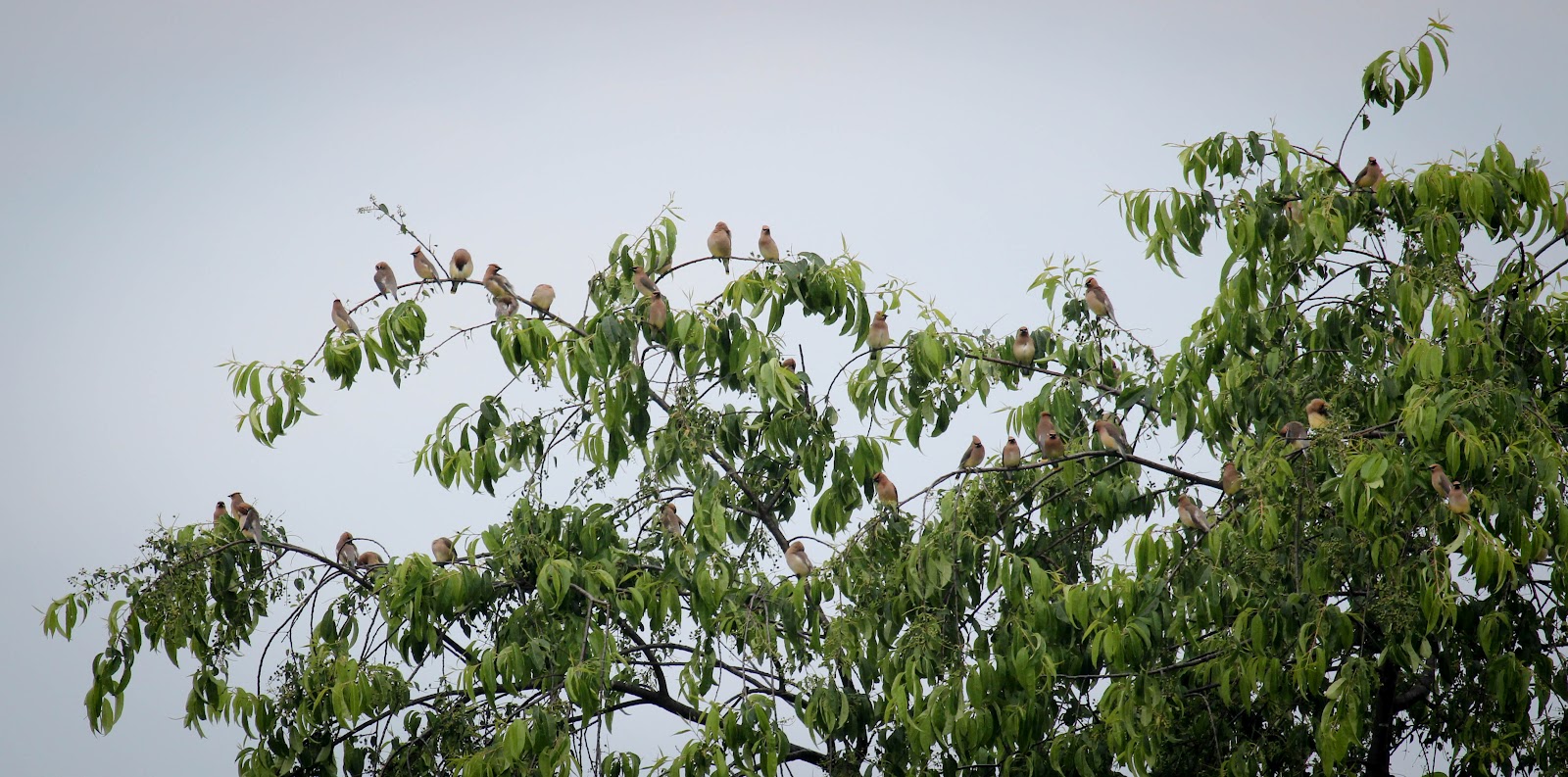
100 Cedar Waxwings Can't be Wrong! Plant a Black Cherry!

I'd been hearing Cedar Waxwings in the area for the past few days, now I know why, Black Cherries!
 
   We who garden for nature don't really need an excuse to add another plant species to our yard, but in case you do ;) or you're actually more of a birder than gardener, let me recommend our native Black Cherry (Prunus serotina). Jeff and I call this particular tree the "Flicker Tree" because in winter we often see Flickers hanging out in the top. This tree actually sits on the far edge of our neighbors yard but we have a clear view of it, and so do the birds. It happens to be the highest vantage point around, which makes it the perfect roosting spot for the birds and bird watching target for us. The fact that it a fruiting tree makes it all the more attractive, making the insects buzz with delight in the spring and a living bird feeder in the summer. Some of the birds we regularly see here are, of course, Cedar Waxwings, Bluebirds, Flickers, Downy and Red-bellied Woodpeckers, Kingbirds (when in the area), Cooper's Hawks, Robins, and occasionally a Kestrel. I'm sure I'm forgetting a few.
   So there you have it, plant a Black Cherry and get yourself some nice binoculars to watch the action that will surely ensue!

Hey guys, they're not even ripe yet!

The "Flicker" tree, as viewed from our yard, a classic double trunked specimen

Wednesday, May 23, 2012

(Almost) Wordless Wednesday: Snakes!


Uh, ahem...Jeff happened to come across these two black snakes gettin' familiar with each other and managed to capture this video with his iPhone. They are seriously twisted up tight!


Pretty wild, don't you think?