Pages

Monday, May 28, 2012

The Brown Headed Nuthatch: Courage and Comedy

   You can't always rely on the experts, we're not supposed to have Brown Headed Nuthatches here in Roanoke, Virginia, but you better believe we do. They're supposed to be restricted to the pine forests of the Tidewater and Piedmont areas of the southeast, but somehow we've managed to have a reliable population for several years here in the mountainous southwest of the state. Small, fast, and animated like a Chickadee, the BHNH (birder code) will surely win you over if you see one, or in my case, nine! Yes, I counted nine individuals as they flew away from our feeding station, presumably two parents and seven offspring. Clutch size is usually between 3-9 eggs, so seven is not uncommon.
   Needless to say, we feel extremely fortunate to have provided a habitat for these birds, even though they didn't nest specifically here in our yard, the parents have been visiting very regularly all Spring. These little dynamos have squeaked their way into my heart, I can't help but smile any time I hear their call. You can learn more about them and listen to their unique call here at the Cornell Lab.

Courageous, because they tolerate my presence quite well, much like Chickadees and Downys.

Comedic, because, well, they sound like a dog's squeaky toy and they're just plain silly to watch.


Here's an adult BHNH accompanied by a male House Finch, for size comparison

Typical nuthatch acrobatics...

Do you think they get headaches?

Juvenile BHNHs have grey heads instead of brown

Friday, May 25, 2012

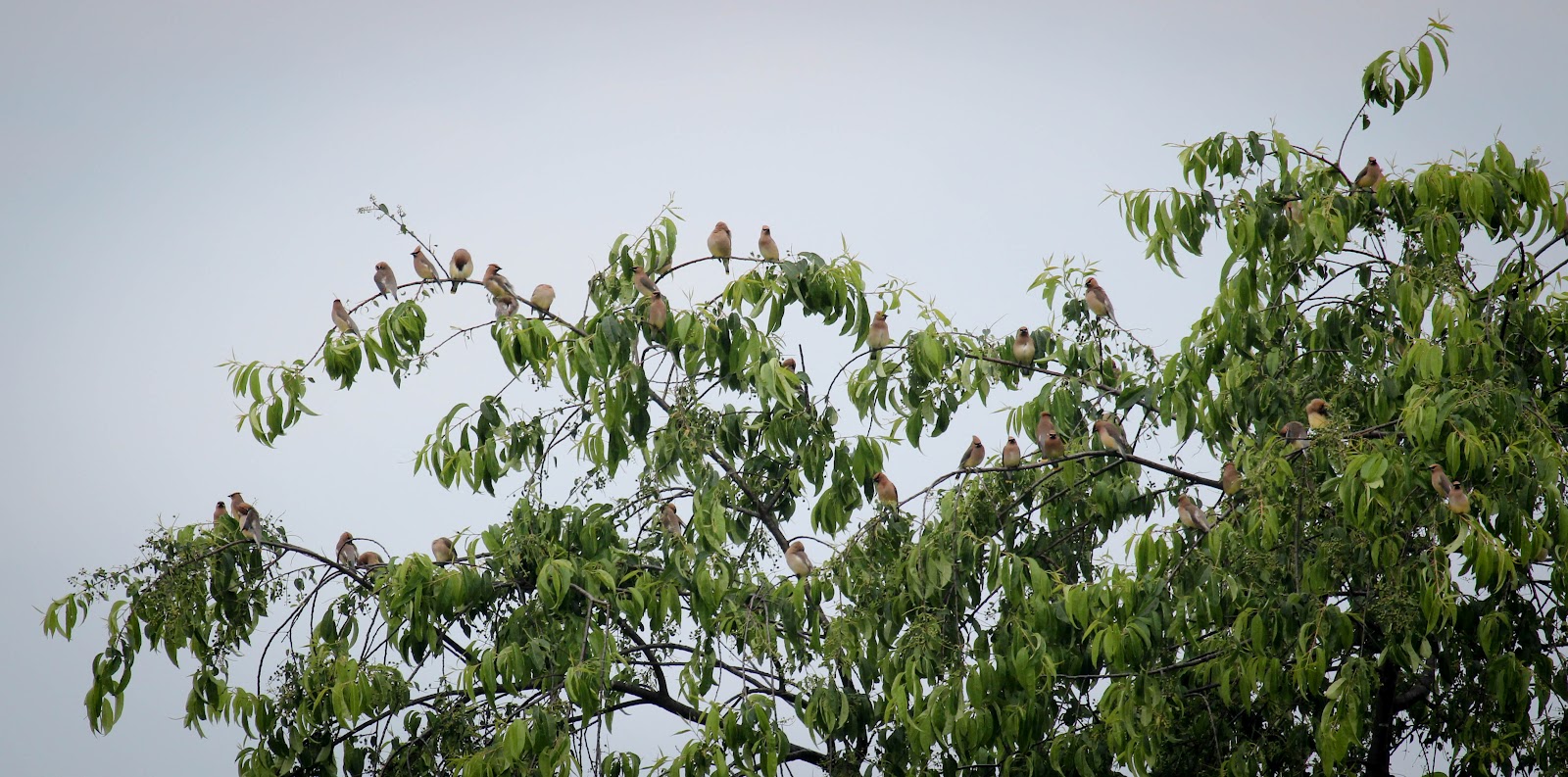
100 Cedar Waxwings Can't be Wrong! Plant a Black Cherry!

I'd been hearing Cedar Waxwings in the area for the past few days, now I know why, Black Cherries!
 
   We who garden for nature don't really need an excuse to add another plant species to our yard, but in case you do ;) or you're actually more of a birder than gardener, let me recommend our native Black Cherry (Prunus serotina). Jeff and I call this particular tree the "Flicker Tree" because in winter we often see Flickers hanging out in the top. This tree actually sits on the far edge of our neighbors yard but we have a clear view of it, and so do the birds. It happens to be the highest vantage point around, which makes it the perfect roosting spot for the birds and bird watching target for us. The fact that it a fruiting tree makes it all the more attractive, making the insects buzz with delight in the spring and a living bird feeder in the summer. Some of the birds we regularly see here are, of course, Cedar Waxwings, Bluebirds, Flickers, Downy and Red-bellied Woodpeckers, Kingbirds (when in the area), Cooper's Hawks, Robins, and occasionally a Kestrel. I'm sure I'm forgetting a few.
   So there you have it, plant a Black Cherry and get yourself some nice binoculars to watch the action that will surely ensue!

Hey guys, they're not even ripe yet!

The "Flicker" tree, as viewed from our yard, a classic double trunked specimen

Wednesday, May 23, 2012

(Almost) Wordless Wednesday: Snakes!


Uh, ahem...Jeff happened to come across these two black snakes gettin' familiar with each other and managed to capture this video with his iPhone. They are seriously twisted up tight!


Pretty wild, don't you think?

Monday, May 21, 2012

Praying Mantis Hatch!

*Sorry I've been absent for a few weeks, between rehabbing my foot, playing catch-up with the gardens, and getting ready for and going on a week long trip to Cape Hatteras, blogging had to take a backseat.

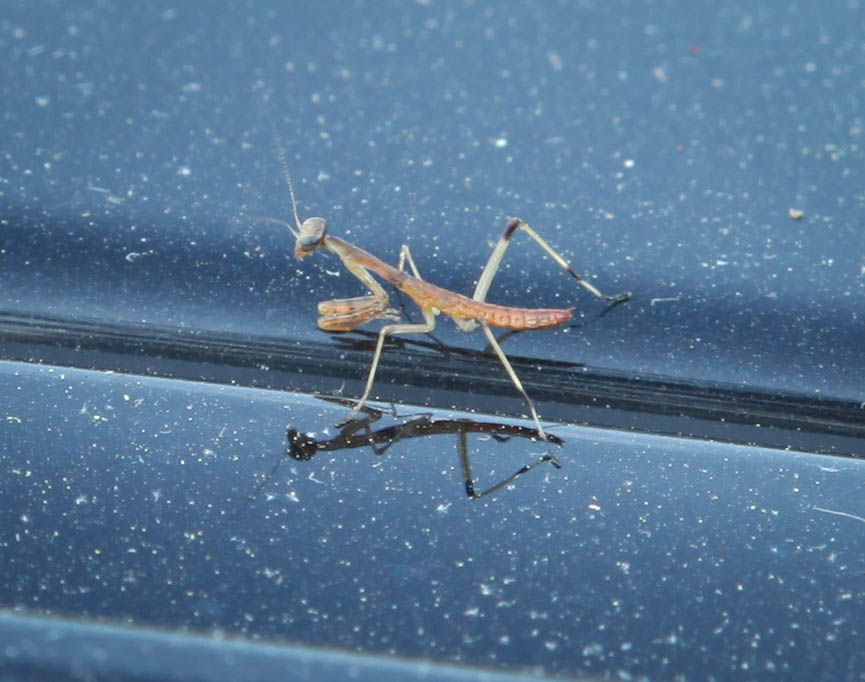
So, where was I...oh yeah! The praying mantises (what is the plural of mantis? mantids? I like the sound of mantises better :) ) finally hatched and I was lucky enough to notice. It happened sometime in the week before last, and being a lover of mantises, it was awesome! There had to be at least a hundred or so of those little micro buggers emerging from that egg case. Although I read they're supposed to disperse and rarely are seen again, I'm still seeing dozens in the surrounding flower beds. I guess all that work making our yard a happy habitat is paying off. By the way, have you noticed more insects this year? (particularly bad ones like earwigs) I sure have, perhaps as a result of our mild winter?

For all you (beneficial) insect lovers out there, feast your eyes upon this...

Getting the camera to focus on the right thing was SO HARD! Here's one squirming out of the egg case.

Look at all those mantises! By the way, they're on a Caryopteris shrub and they are not responsible for the leaf damage you can see here, some other yet to be unidentified bug is.

Totally rad, dude! I wonder what could they possibly be eating since they themselves are so tiny (8-10mm).

Sunday, April 29, 2012

A Most Unusual Trillium

   On Saturday afternoon I headed out to Green Hill Park to revisit the magic spot Jeff and I found two weeks ago. I wanted to see if the False Solomon's Seal was blooming yet, and to look for new stuff we might have missed the first time. Needless to say, my heart skipped a beat when I found this! All of the other Trilliums in this patch of forest had long since finished blooming, in fact, not much was in bloom at all so if you were looking for wildflowers like I was, this gem was easy to spot. Researching it on the internet turned up little more than it's likely a mutation of a Trillium grandiflorum, which is the predominant Trillium in these woods. Unfortunately they are also considered a "Holy Grail" among some unscrupulous wildflower enthusiasts and therefore are a favorite of poachers. Well, I ain't tellin' anybody where I found it, jes' in case!

I'm curious just how common or rare these might be, have you ever seen one?

I found it in a "wash" area, a slight gully where water washes down in heavy rain

The coloring was white tinged with green and pink, beautiful!

Here's the area where I found it, I love this place! Notice all the cool plants? 

Saturday, April 21, 2012

Best Bugs O' The Week

   This week we have finally started seeing some real quality insect activity. I expect (and hope) any day now I should find the first Monarch eggs on my milkweed plants. Last year I noticed them in the final week of April and since we're about two weeks ahead of schedule it should be soon. Until then, however, here are the highlights of the week...

Diana Fritillary caterpillar, oh how I'd love to see the butterfly! They are very unusual in that they don't lay their eggs on the leaves, but typically on a twig next to the plant. The larva then hatch in the fall and overwinter underground, then emerge to feed on the violet leaves come springtime.


Well, not a picture of an insect, but of insect activity!

Finally we have nesting Mason Bees! They didn't use this bee house last year, and this year we only have three holes filled, but hopefully as our habitat improves, so will the bee population.

Can you see it? It's pretty tiny...

I had to crop this image pretty heavily just to show the detail on this fella, those are grains of pollen around him. A dime would crush him. The praying mantis egg cases are finally starting to hatch, I hope some of them stick around this summer!

Not a bug, of course, but definitely beneficiaries of the increase in insect activity. I can hear the peeps of the baby Bluebirds from our deck every time a parent lands on the nestbox with a snack.

Swamp Milkweed Leaf Beetle, munching on Orange Milkweed (Asclepias tuberosa). I'm always confused what to do when I see one of these, should I flick it off to save the milkweed for monarchs or leave it be, he has a right to eat the milkweed too.

Unidentified Cranefly sitting on a sunflower leaf. Gotta be the weakest flying thing in the insect world. This image was also enlarged a bit to show detail, until now I had no idea Craneflies look this interesting, kinda like a dragon, maybe.

Sunday, April 15, 2012

You Never Forget Your First

White Trillium (Trillium grandiflorum) aka Large Flowered Trillium

   Married for 16 years and celebrating in our own special way, Jeff and I spent the afternoon of our anniversary at Green Hill park hoping to see something special on this special day.
  Although we did see about a hundred Zebra Swallowtail butterflies congregating around the Paw Paw groves (their host plants), we were having a hard time finding anything interesting in a place that was full of wildflowers last fall. We were getting tired and were just about to leave when Jeff pointed up the hill and said in his typical silly but serious way, "All the good stuff is probably up there...those woods are probably full of Trilliums" (a plant we have never seen, but desperately wanted to). Still restrained by crutches and therefore unable to climb steep trails, I agreed, naturally where I couldn't go is likely where all the good stuff is!
   So, Jeff wheeled the car over as close as we could get to the bottom of the hill and just for kicks, I got out the binoculars to see if I could see any flowers through the woods.
   "Uh, stop the car!" I saw something, a lot of something, and it looked like wild geranium from a distance (turned out to be tons of white violets). I panned the binoculars up and lo and behold I saw what looked like a Trillium! Really! We parked, got out, stepped into the woods, and were greeted with a patch about the size of an acre of what must have been hundreds of Trilliums! And other cool plants too! Happy Anniversary to us!
   All the times we'd been to this park before, even this spot on this trail, we'd never been here at the right time, we had no idea these plants were here, hence the ephemeral-ness of spring ephemerals. Thank you little violets for getting my attention and making me look, besides them and the Trilliums we also found False Solomon's Seal, Mayapple, Twinleaf, Bellwort, Dwarf Larkspur, Sweet Cicely, Bugbane/Black Cohosh, Hepatica, Blue Cohosh, and numerous Sedges. There could have been more, but the plants were so thick carpeting the forest floor and the slope was so steep that it was hard to see everything. It was a magical sight.
   Needless to say, I'll never forget my first Trillium.

Here's a sampling of some of the plants we saw...

Another White Trillium

The petals turn pink as they age, in fact most of the ones we saw were actually pink.

Canadian White Violet (Viola canadensis) aka Tall White Violet

Blue Cohosh (Caulophyllum thalictroides) kinda late in its blooming cycle with only one flower left

False Solomon's Seal (Maianthemum racemosum) not yet in bloom

Dwarf Larkspur (Delphinium tricorne) in one of the sunnier spots, flowers can be white, lavender, or purple

A large patch of Twinleaf (Jeffersonia diphylla) also enjoyed the sunnier spot but unfortunately was not blooming that day

A hodge-podge of loveliness