Pages

Friday, September 30, 2011

Another First for Me: Lobelia Siphilitica


   I was just out minding my own business, looking for some Jewelweed to collect some seeds from. Earlier in the day, during a bike ride, I saw some growing in a creek along the side of a quiet road. It's hard to find some that isn't surround by poison ivy. That afternoon, as I turned up the road in my car, I looked for a place to pull over, but I had some one behind me and the only place to park off the street was in front of a No Trespassing sign. So, I kept going, hoping the guy behind me would turn into a driveway. In the process, I went further up the street than I had planned, and stumbled upon a section of the creek even better than the first. I knew it as soon as I saw it, Great Blue Lobelia!


   I have never seen any growing in the wild before, and there was a lot of it! The pollinators were all over it! It was such a magical little spot, growing amongst the Lobelia was Swamp Milkweed (also first time seen in the wild, not a garden), Jewelweed, Wingstem, several Asters, some unidentified sedges, Boneset, PawPaw trees and a couple non natives, Polygonum persicaria, and something that looks like a helenium, but I'm not sure. The color combinations were simply stunning. Roanoke is typically such a dry place, I'm not accustomed to seeing these moisture loving plants.

Spotted Jewelweed

Polygonum persicaria (I think)
Unknown?
Boneset

   I found this spot totally by accident, and yes, I did manage to collect some Jewelweed seeds, despite half of them "popping" into the creek before I perfected my technique, hence the other name Touch-Me-Not. The source of this little creek full of magic is a spring at the base of a mountain. Here's a picture of what I assume is some kind of community springhouse, it was one of the few places not to have a No Trespassing sign. Water was coming out of a pipe and seeping out of the corner of the foundation.


   The diversity and richness of this random spot along a nondescript country road will have me coming back to see what's blooming for a long time. 

Wednesday, September 28, 2011

Found! Our first Wild Liatris

Sorry for the less than stellar image quality, it's an iPhone

   I shouldn't say "our" because I haven't seen it yet, in person. I should say "Jeff's", he found it, took its picture, and I identified it. He's been carrying his iPhone with him on his trail runs because he's been seeing what he believed to be some quality plants. It would take just about all day to hike up and back to the ridge with the good camera and tripod, but much less time if he's running.
   I've never seen Liatris growing in the wild before, so this is exciting. I think it looks like a Liatris spicata. Based on the remoteness of the location, high on a ridgeline, deep in a Natural Preserve, miles from civilation, I don't think this is an escaped cultivated specimen. This particular mountain area is one of the few in this area where you won't see any introduced species, it seems quite pristine.
   Thank you Jeff for this excellent find!


Monday, September 26, 2011

Monarchs are on the Move! Birds, too!

    We started seeing Monarchs heading south about a week ago, here and there, but over the weekend we started seeing them more consistently, even groups of three or more. Yesterday, where ever I was in town or at home, all I had to do was look up and I was guaranteed to see Monarchs heading south, just a constant stream of orange and black. My parents, who live north of us, also reported seeing them in a constant stream across the sky. Always about the same altitude, never coming down to feed, just floating away. That's why I don't have any photos, it would just be a black spot against a washed out sky, if that even. If I didn't look up, I'd probably miss them.
   So if you're near Virginia or further south, start looking! They're coming your way!

   A birding note...we've also had some nonstandard birds in the yard, a Pee-Wee spent the afternoon hunting from the tips of our hawthorn trees, some warblers (probably Pine) have been passing through the treetops, and a Red Shouldered Hawk has been heard calling (they're very vocal!) at the pond across the street several times. Another winter visitor, a Brown Headed Nuthatch, has been heard in the pines on the golf course. We hear it every year but rarely see it. One lucky winter we had a pair of Brown Headed Nuthatches come to our feeders regularly, but they seem to spend most their time in the pines.

Friday, September 23, 2011

Mysterious Eggs Update

*This is not an eggs update that happens to be mysterious, it's an update on some mysterious eggs!

   Well, I found the egg mass by chance, 12 hours later they'd hatched, 12 hours after that, you would never know they had been there! I haven't been able to ID them, but I have a few guesses. I was thinking maybe sawflies, now I'm thinking some kind of moth. When they were still on the plant, if I tapped the stem, the tiny 1 millimeter caterpillars would drop from a strand of silk, and the stem they were on was covered in silk by the time the left. It was hard to see, but they moved like an inchworm. That makes me think moth. Maybe a type of cutworm moth. That's the best I could do, unless I see something getting massively defoliated, I'll probably never know for sure.


Click on the picture to see a larger version, it's hard to get the camera to focus on 1 millimeter caterpillars.


Wednesday, September 21, 2011

A Plant that Found Me, Awl Aster

   I have this habit. If a plant sprouts up and I don't know what it is, I like to let it grow and flower so I can identify it and add it to my memory bank. If it turns our to be a desirable plant, I leave it. If it turns out to be an evil plant, I pull it up before it goes to seed. One particular new plant that sprouted up this year is pictured below...


   It's the leaning one, growing out of a crack between the bricks in the sidewalk. I had no idea it would get so tall, right now it's about five feet, and it's a bit awkward to walk around. Hurricane Irene blew it over, and it never quite straightened up. Now that it finally has begun to bloom, I think I've Id'ed it: Awl Aster, or Frost Aster, or Old Field Aster. The latin name seems to be Aster pilosus, or Symphyotrichum pilosum.


   Typical of asters, the flowers are small and white, and the stalks are quite rigid, almost woody at the base. Based on the size of this plant, there will be literally hundreds, if not thousands of flowers. It's hard to believe this huge plant grew from a tiny seed in just one season. It sure wasn't there last year, and I haven't seen any others around. I can only wonder how it got here. I think it's quite attractive, I just wish it was at the back of this border, not in the middle of the sidewalk. I would love to transplant it, but I don't think it will come out of the crack. Maybe I can collect some seeds and sow them elsewhere...


   It's been quite popular with spiders, particularly Long Jawed Orb Weavers, who've built numerous webs on this plants all summer long.


   Something has laid a mass of eggs on a stem, I have no idea what they are...And by the way, if you think I may have incorrectly identified this plant, please feel free to correct me.

So, you never what you might get, let that weed grow and it may just turn into a keeper!

Monday, September 19, 2011

A Few More September Blooming Natives...

 Crownbeard (Verbesina Occidentalis)

   I've really enjoyed looking for and finding some new wildflowers lately. The rains we had a few weeks ago really set the stage for a spectacular show. One of the the most common, and therefore probably most overlooked native plants in this area is Crownbeard (Verbesina Occidentalis). To some people it's a weed, to me it's a glorious golden pollinator buffet.

Crownbeard and happy honeybee

   The honeybees are really enjoying it right now, as are the many other insects. The flowers themselves have a rather disheveled look to them, maybe that's why gardeners don't care much for this plant, but the pollinators don't seem to mind. Crownbeard can easily reach six feet tall in dry, partly shaded soil, growing easily in difficult spots. It's even a host plant! (For the Silvery Checkerspot)

Blue Sky Aster (Aster azureus)

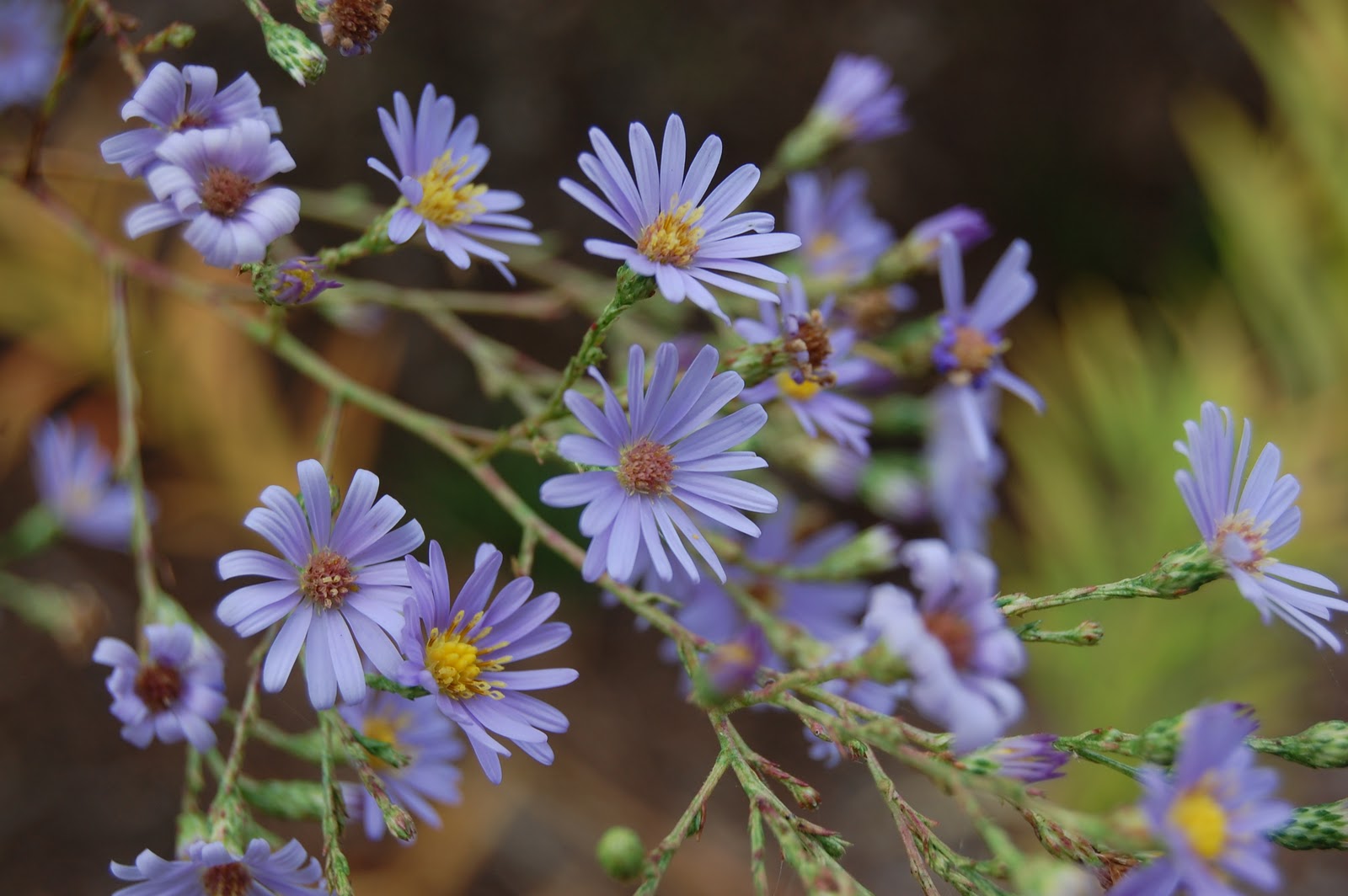
   One of our many new plants for us this year is Blue Sky Aster. I ordered it from Prairie Moon Nursery back in the spring. It bloomed well for us in it's first year and is gorgeous! Typical of asters, the small 1 inch flowers appear on long airy stems, 2-3 feet tall. I must order more of these next year!


   The latest new plant we've found over at Dean is Black Nightshade (Solanum nigrum). Jeff found it and suspected it might be a quality plant, so he snapped these shots with his iPhone.


   The berries are more noticeable than the flowers on this shrubby little plant, and presumably have some medicinal value. However, I'm not going to be experimenting with eating anything with nightshade in the name! 

Sunday, September 18, 2011

TARDY TO TH' PARTY...

Late Sunday greetings to all! Well, I intended to do a brilliant post today but things got out of control. A bit of exercise in the AM, a quick lunch with hubby, and afternoon house hunting with my parents (for them). As a result, my time in the garden was a blur.
 

Hopefully tomorrow will be a little slower and my next post a bit closer to brilliant.